E-Type sing their dance hit "Eurofighter":
"The time is now
We won't back down
When we stand united we can save the day
Eurofighter
It's now"
Is it just a catchy song, or EU propaganda?
Thursday, November 29, 2007
A song for a EU common military force?

'Nervousness' in Brussels due to unclear treaty
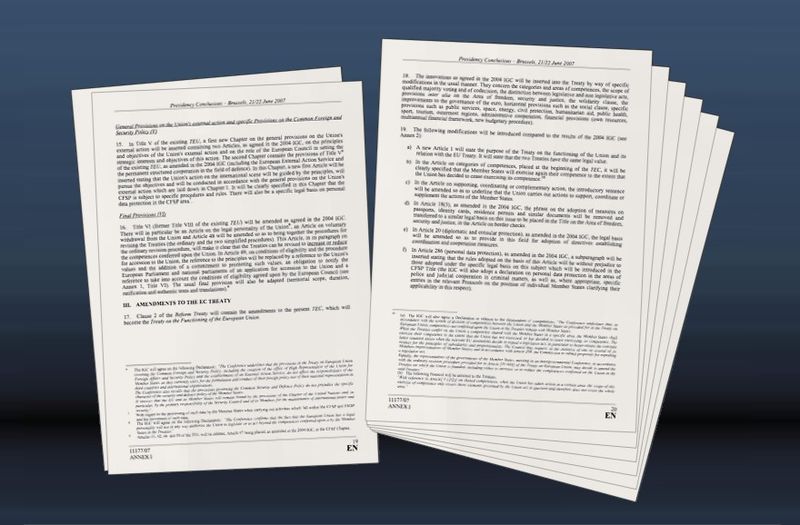 Because of its unclear division of power, analysts and politicians are not sure rather the EU's new Treaty is going to work in practice. In the Reform Treaty there will be three big jobs in Brussels: the president of the European Commission, the president of the European Council and the EU High Representative for Foreign Affairs and Security Policy. These three have overlapping job descriptions that are set to be defined only by the strength of the personalities involved, meaning that the treaty, agreed in October after years of wrangling, could be laying the ground for a political hornet's nest according to the EUobserver.
The EU's latest treaty will be put into place in 2009. European commission president Jose Manuel Barosso already publicly expressed his concern about the role of the EU in the future last month. ''The danger exists that the governments will handle problems among themselves, without taking into account the European instituions,'' he said in an interview.
EU ambassador for Slovenia, Igor Sencar, said at the European Policy Centre think tank in Brussels that he already feels the ''nervousness'' in Brussels about the lack of clarity in the document. His country will run the EU during the first half of next year. He indicated that the issues will have to be dealt with by EU leaders and that a "common view" should be drawn up by the end of next year.
Dr Andreas Maurer from the German thinktank Stiftung Wissenschaft und Politik in a recently published paper notes that the future EU president, who can hold office for up to five years risks becoming EU leaders' "play ball" because the office lacks its own ministry.
The paper asks if the new president has sufficient personnel, administrative and financial resources at his disposal to carry out duties such as leading, preparing and giving a sense of continuity to leading EU projects, such as on climate change and energy.
Monday, November 26, 2007
Cohesion works!
At least that’s what Charles White tried to convince us about during his presentation in
- Not only do we see that cohesion works in EU member states, but that counties like China, Brazil and the US learn from our way of dealing with these types of problems, said White, which used most of his presentation to present the new four main targets for cohesion policy in the budget period 2007 to 2013, which he listed as the following:
- Achieving growth and sustainable development
- Globalisation and restructuring
- Dealing with aging population and slower growth
- Ragnhild
Audiovisual service
Sharing the sights and sounds of Europe
While many see the European Union as a bureaucratic fortress, the EU itself at least tries to be more transparent for the citizens of the Single Market. The European Commission’s Audiovisual Service daily upload pictures, videos and audio, of what’s happening in the Commission. They have a broad archive, which also contains pictures and videos from the European Unions history. European audiovisual material dating from the 1940s is available.
It is easy to find what you need, there are several searching possibilities, and you can search thematic. Journalists are (almost) free to use these tools as they self prefer, as long as they credit the European Community. Press briefings and other important meetings are broadcasted as they are taking place. All the materials are available in professional standards. It is also possible to borrow TV-studios in the ‘Audiovisual services’ facilities.
This audio is from the website, and is an old archive clip of Willy Brandt. (Audio©European Community 2007)
- Ragnhild
Thursday, November 22, 2007
Singing in the Ruhr
It has been used for music videos before, but - ooooops, we did it again.
- Ragnhild
Tuesday, November 20, 2007
EU wants to handle Kosovo issue
 The EU warned Kosovo's probable new prime minister that it shouldn't rush a unilateral declaration of independence.
Former guerilla leader Hashim Thaci, who is expected to become prime minister of the majority ethnic Albanian province after Saturday's election, said parliament would declare independence after a December 10 deadline for international mediation efforts - a move that would almost certainly be resisted by Russia, the Daily Telegraph reported from Brussels today.
The EU is anxious to avoid a repeat of its dilemma in the 1990s, when internal splits over how to deal with the Balkan wars showed its ineffectiveness as a foreign policy player, letting the US handle the crisis.
"This is a European challenge. It is not one we can ask the United States to solve for us," said Jim Murphy, Britain's Europe minister.
Kinia
Saturday, November 17, 2007
EU Environmental Policy Still Up in the Air

The European Union's place at the forefront of environmental policy will be solidified if its newly proposed legislation passes: EU representatives are pushing for a cap on emissions for commercial airlines flying to and from Europe.
The International Herald Tribune reported that the new plans faced harsh criticism from the US airline industry, who could potentially bring Europe to court at the World Trade Organization for unfair trade practices. They argued that it "broke with international aviation practices, would cost companies billions of dollars and could lead to sharp increases in airline ticket prices." Carl Burleson, the director of the office of environment and energy at the U.S. Federal Aviation Administration, also said that the EU should not make such decisions unilaterally, and instead needs to discuss the agreements with all the international governments involved.
Still, the US isn't the only party upset about the proposed emission restrictions. International airline companies are equally displeased. According to Taneli Hassinen, a spokesman for Finnair, the new system would cost the airline €50 million per year, if not more.
Thus, as is often the case, a struggle exists between beneficial environmental practices and economic viability. And while the EU remains a strong leader in terms of protecting the environment and respecting environmental laws, whether or not it will be able to stand firm against US and airline company pressure, remains to be seen.
- Jillian -
Thursday, November 15, 2007
Write about EU enlargement... and win a trip to the Balkans
 A competition launched by the EU aims to encourage young journalists to enter the market.
Young journalists aged 17-27 from all the EU member states as well as from candidate and potential candidate countries (Western Balkans and Turkey) are invited to submit to the competition a recently published article on EU enlargement (publication date between January 2007 and 15 March 2008).
The Commission's Directorate-General for Enlargement in cooperation with the European Youth Press association launched today a pan-European competition for young journalists from all over Europe. The objective of the competition is to encourage young journalists to reflect and express their views on the European Union's enlargement policy.
“Enlarge your vision” - European Young Journalist Award on EU Enlargement
Brussels, 15 November 2007
“Enlarge your vision” - European Young Journalist Award on EU Enlargement
The Commission's Directorate-General for Enlargement in cooperation with the European Youth Press association[1] launched today a pan-European competition for young journalists from all over Europe. The objective of the competition is to encourage young journalists to reflect and express their views on the European Union's enlargement policy.
On the occasion of the launch of the competition, which will run from 15 November 2007 to 15 March 2008, Commissioner for Enlargement Olli Rehn said: “I welcome the launch of this competition and look forward to learning more about the views of young journalists on the enlargement policy. They are important opinion-leaders for their generation. I would like to invite them to share their experiences and visions of our common European future. Their ideas will further nourish the debates that will determine the shape of our continent.”
The participants can enter the competition on a special website created: www.EUjournalist-award.eu. There, they can also read articles on the EU's enlargement policy and find interesting tips for a career in journalism. At the end of the competition in April 2008, national juries made up of media representatives will select a winning article for each country and these articles will be published on the competition website. All 35 winners will be invited on a joint trip through Balkan countries and will have the opportunity to participate in a closing conference with media representatives from various countries in June 2008.
Kinia
Another Round of CAP Reform...

The European Commission announced that on November 20, it will present a new proposal to cut agricultural payments for big farmers and instead finance more rural development projects. The exact figures of the subsidy cuts remain uncertain and will only be decided upon next Spring.
Still, Commission agricultural spokesman Michael Mann said on November 7 that "'perhaps' the plan could entail a 10% reduction in payments for all farms receiving more than €100,000, 25% for those getting more than 200,000, and 45% for those above €300,000." (http://www.euractiv.com/en/cap/eu-plans-subsidy-cuts-big-farms/article-168205)
The proposal will no doubt face stern criticism, but not necessarily from the usual suspects, or in this case, the usual opposers of CAP reform. In fact, France (which historically has been opposed to CAP change) will not be drastically affected since while it receives a high level of total subsidies, it is composed primarily of smaller farms. Instead, Great Britain and Germany will likely be against the new set of reforms since most of Europe's biggest farms are concentrated in these two countries.
Nonetheless, NGO farmsubsidy.org reported that the cuts will only affect 0.3% of subsidy recipients, thereby reducing CAP subsidies by €554 million (only 1.7% of all payments).
So, ultimately, whether or not this new set of CAP reform will effectively pass is one question. The other, and perhaps even more important query, is whether these changes will actually alter how Europe deals with the big business that is farming, and by extension, agricultural spending.
- Jillian -
Wednesday, November 14, 2007
Cheaper communication coming soon to a EU country near you
 A new EU proposal to reform the EU telecoms rules should give EU consumers more choice, better prices and accessibility for cell phone, internet and other telecom services. "From today onwards, a single market without borders for Europe's telecoms operators and consumers is no longer only a dream," said José Manuel Barroso, President of the European Commission. "Telecoms is a field where our single market can bring about very concrete results for every citizen in terms of more choice and lower prices, whether for mobile phones or for broadband internet connections."
The "Telecoms Reform Package", which was presented by the Commission to the European Parliament in Strasbourg today, will change the EU Telecoms Rules of 2002. It is expected to become law by the end of 2009. It includes more consumer rights (quickly switching telecoms operators), more consumer choice, more security, more independent watchdogs, etc.
Kinia
Tuesday, November 13, 2007
European Defense

France has announced it's intentions to push for a Europe based defense when it takes the EU presidency in the second half of 2008. The defense would include a Brussels-based EU planning staff, exchanges between professional soldiers and a harmonization of military educations. However, these proposals will likely raise concerns from fellow member states.
As reported in an EU Observer.com article, French defence minister Hervé Morin said that Paris will put defence high on the agenda when it takes over the rotating presidency. Morin when on to say that defense was an absolute priority which is at least as important for European integration as the EU's common currency.
"With the common currency, we have created a strong symbol for Europe. But nothing can better express the European community of fate than common defence, a common sense of Europe's threats and security interests," he said.
Morin said that Paris is still coordinating with its EU partners about the logistics of the proposal but "independent crisis capacities" for Europe would be one key goal.
However France is not going to push this agenda with ease. It is likely to face skepticism from the United Kingdom which dislikes the idea of an EU defence headquarters and would like European defence forces to focus on peacekeeping and humanitarian tasks. The UK traditionally sees combat operations as part of NATO.
Nicolas Sarkozy however is strongly pushing for a military role for the EU which is independent from that of the Atlantic alliance. Mr Sarkozy has said he would like France to re-join the military command structures of NATO, but on the condition that EU defence is also strengthened.
-Kurt Hickman
Council of Europe against anti-terror policy
The procedures that the EU and UN use to place suspected terrorists on a black list is "completely arbitrary", and are in contradiction to the democratic principles, according to the Council of Europe, the organization that overlooks human rights.
With the draft-report on blacklisting by the legal council of the parlementary assembly of the Council of Europe, the council hopes to change the methods that are currently used to counter terrorism threats.
'To be effective, the struggle against terrorism has to be believable', Dick Mary said. He is a Swiss senator in the parlementary Assembly and he wrote the report on blacklisting.
The report states that there are no procedures to check the choices that are being made about suspected persons. Some people can be added to the black list without proper suspicions and they are unable to defend themselves against it.
Suspects on the black list may face the closing of their bank accounts or restrictions on free travel.
- Peter Fijbes -
EYOU-Tube
Youtube is evolving into much more than just a platform for music, tv and comic videos. The European Comission is also active on Youtube. But they're not the only ones that upload footage on the EU, eurosceptics use the platform to spread their views too. An overview.
The European Commission has its own Youtube account. The video's posted here are (of course) all positive. They post video's with titles like: "What does equality mean to you" and "50 years of protecting the European Environment.
The Video's don't just show the marketing video's that the EU creates, but they express their views and ideals on Europe too. The following video is on an program that wants better informed European Customers.
That opinion that the EU is not only beautiful but might be negative too cannot be found on the page of the European Commission. Others actually do express that feeling and upload video's that are more sceptical in nature. For instance, the following video on Barrosso. He said that the EU will be comparable to an Empire when the new treaty is put into force. On Youtube, this led to many angry reactions.
Another, even more sceptical video is called: "The Real Face of the EU in 10 minutes". It starts with the opinion that 'we are decieved'. And it also states that the European leaders conspire and keep us from the real truth.
- Peter Fijbes -
British Queen benefits from CAP
 According to the British daily The Independent, estimates published earlier this year showed that the Queen, one of the wealthiest women in the world, receives approximately £404,000 a year in European subsidies for her Sandringham estate and at least £140,000 for Windsor Castle.
-Kinia
Members of the Danish Royal Family were also among those receiving some of the largest farm subsidy payments, The Independent claimed, basing itself on a survey by farmsubsidy.org
The European Commission is drafting a proposal to limit subsidies for rich landowners. The plans, due to be submitted for consultation with EU member states on 20 November, will suggest that some of the largest payments to super-rich landowners and industrial farms could be reduced by as much as 45 per cent, The Independent claims.
Monday, November 12, 2007
EU willing to work with OPEC on oil prices
ROME - As the oil price spikes to nearly $100 a barrel, EU commission President
Jose Manuel Barroso says he willing to work with the OPEC to make the oil market more transparent.
Barroso also stated that he believes in the dynamics of the free market and pleads for the oil prices to be revealed instead of regulated. "We resist regulation. We believe in markets," Barroso told journalists at the World Energy Congress in Rome.
Last week, Abdullah al-Badri, the Secretary General of the OPEC, said he wanted more rules and regulations to prevent oil speculation contaminating the normal supply and demand dynamics.
- By Peter Fijbes-
Saturday, November 3, 2007
All Europeans are equal, but some Europeans are more equal than others.

According to a European directive, member states are allowed to limit freedom of movement if they want so. Italy said it wanted to expulse thousands of Romanians. It had already started in Rome and Milan.
Nicolas Van Caillie
Italian police begin to round up Romanians
Italian police yesterday began combing shantytowns in Rome and other big cities to locate Romanians targeted for expulsion under legislation introduced after the gruesome murder of a woman on the outskirts of the capital this week.
One small makeshift settlement near the centre had been bulldozed by midday and its inhabitants bussed away for identification. The clearance of another site, where the alleged killer of the murdered woman lived, was held up only at the request of forensic science experts so that they could finish their hunt for clues.
Carrying their belongings in bundles and plastic bags, residents fled the camp in a quiet part of northern Rome as police stood ready to tear down their shacks, already made sodden and fragile by recent heavy rain.
The prefect of Rome, Carlo Mosca, said: "I shall sign the first expulsion orders straightaway. A hard line is needed because, faced with animals, the only way to react is with maximum severity." Italian media reports said the police were anticipating several thousand expulsions.
Mr Mosca's comments, which did not prompt controversy, came amid a nationwide outcry over the death late on Thursday of Giovanna Reggiani, the 47-year-old wife of a navy captain. Ms Reggiani was robbed, sexually assaulted, beaten and then dumped in a ditch near her home.
A Romanian of Roma origin, Nicolae Mailat, 24, was remanded in custody by a magistrate yesterday, accused of murder, sexual assault and theft. His duty lawyer said he had only admitted to stealing Ms Reggiani's bag.
The killing was the latest in a string of ugly crimes this year blamed on Romanians, who form Italy's biggest immigrant community.
An MP from the anti-immigrant Northern League said his party was organising vigilante patrols in predominantly immigrant areas of Turin and Piacenza today and tomorrow. In Rome officials of the Freedom Circles, a network of political clubs set up by Silvio Berlusconi's latest protegee, Maria Vittoria Brambilla, also announced patrols. But Ms Brambilla denied all knowledge of the scheme and said she had not authorised it.
A decree published yesterday which took effect immediately empowered prefects to order the removal from Italy of EU citizens judged to pose a threat to law and order. However, it includes certain guarantees. Expulsion orders need the endorsement of a justice of the peace or, in the case of suspects in investigations and defendants in trials, the approval of a prosecutor or judge respectively. Italy's most senior police officer, Antonio Manganelli, said EU citizens would be treated "with absolute respect for human dignity, without witch-hunts".
But the head of Italy's criminal lawyers' association, Oreste Dominioni, called on his members to protest at the measure, which he described as "authoritarian".
Tens of thousands of immigrants from eastern Europe live in shantytowns in the major cities, and particularly Rome. At the camp demolished yesterday a Russian who gave his name as Sergei said: "I've been here for a year. I've never had problems with the law. I don't know now what the future holds."
sources: The Guardian, Google news, Le Monde.
Subscribe to:
Posts (Atom)